You are used to measuring your preparation in kilometres, long runs and demanding sessions. As the marathon approaches, though, your training plan should start to get smaller. Sessions become shorter, and a workout that felt easy a few weeks ago may now even seem insufficient.
This change in your plan has a very specific purpose. Tapering means reducing your training load before a race so that you reach the start line with less fatigue and can make better use of your preparation. For it to work, you need to understand what to reduce, what to maintain, and why this final period calls for different training decisions from the preceding weeks.
What we want to achieve with a taper
Training produces adaptations, but it also builds up fatigue. After several consecutive weeks of training, how you feel on an easy run is influenced by everything that came before it. The fitness you have built and your ability to express it as a performance on race day are not quite the same thing.
A taper creates room for recovery while maintaining the training stimuli you need. Shorter sessions and lower training volume serve precisely that purpose. A week with fewer kilometres can therefore be an essential part of your preparation, even if it does not add more hard, demanding sessions to your calendar.
In a meta-analysis of 14 studies involving 174 endurance athletes, race and time-trial times improved after tapering, without a corresponding statistically significant increase in VO₂max. When different reductions in training volume were analysed, the largest estimated benefit occurred with a reduction of 41–60%. These findings support the value of reducing training load before a target race. Wang et al., 2023.
The practical point is that feeling more energetic and motivated is not a reason to add kilometres or increase intensity beyond what your taper plan prescribes.
What to reduce and what to maintain in training
To understand the changes, distinguish between three things: volume is how much you run, intensity is how hard you run, and frequency is how many sessions you do. They do not all need to decrease to the same extent during a taper.
The meta-analysis by Bosquet et al., which included 27 studies, found that a taper of around two weeks, with a progressive reduction in volume of 41–60% while maintaining intensity and frequency, generally worked best. These are pooled findings from athletes in different sports, however, rather than marathon runners alone. Bosquet et al., 2007.
To put the percentage into context, consider a simple example: a 50% reduction from a weekly training volume of 60 km means 30 km. This illustrates the size of the change. It does not mean that every runner covering 60 km a week should run exactly 30 km in a particular week before their race, or that another 50% should be removed each week until race day. We need to specify the volume we are comparing against and the stage of the taper we are discussing.
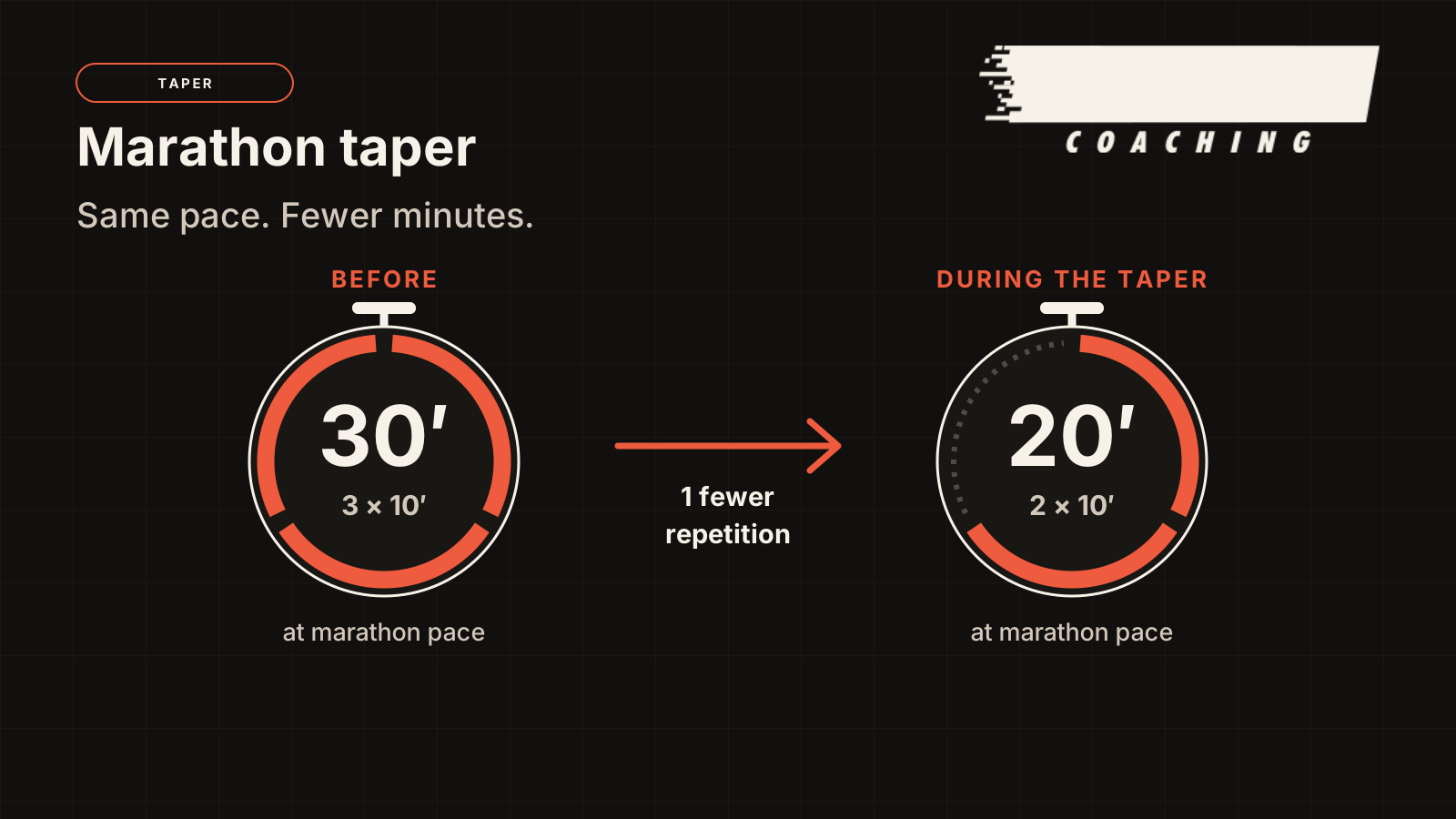
Similarly, maintaining intensity can mean doing less work at a particular pace. For example, a session of 3 × 10 minutes at marathon pace could become 2 × 10 minutes at the same pace: the demanding part of the session decreases from 30 minutes to 20.
Someone who runs four times a week may likewise maintain that frequency while making the sessions shorter. The benefits of maintaining frequency found in the studies are not a reason to increase frequency for athletes who normally run fewer times a week.
When to start and why the duration varies
A large study analysed Strava data from 158,117 marathon runners. The researchers distinguished between different taper durations and how consistently runners reduced their weekly mileage. A disciplined three-week taper involved three consecutive weeks of reductions, without an increase in between.
In the analysis, this approach was associated with an estimated benefit of around 5 minutes and 32 seconds, or 2.6%, compared with runners who had only a minimal one-week taper. The estimate also used each runner’s fastest 10 km training pace as an indicator of their ability. Smyth & Lawlor, 2021.
The researchers observed what runners had already done during their preparation. The result therefore does not prove that changing your taper alone will save you 5.5 minutes. It does, however, show a meaningful association between consistently reducing training load and making better use of your preparation.
The roughly two weeks in the earlier meta-analysis and the three weeks in this study come from different athletes and methods. In practice, we need to consider previous training volume, session frequency, accumulated fatigue, and how each athlete responded to tapering before previous races.
Two runners with the same target may have arrived at the final weeks through very different preparation. One may have followed their plan consistently, while the other may have had interruptions. Sharing a target time is not enough to conclude that they can or should follow the same taper.
That is why both the duration of the taper and the date of the final long run need to be planned within the overall training programme.
Common mistakes to avoid
A common mistake is using sessions in the final weeks to prove that you are ready. If the pace feels easy, you should not add repetitions. If it feels difficult, you should not turn the final sessions into fitness tests. Either way, you will add fatigue that your plan did not account for. Judge your readiness from your preparation as a whole, rather than only from sessions in the final weeks.
The same applies to missed sessions. You do not need to make up a missed interval session or long run just before your race. If there are significant gaps in your preparation, however, discuss them with your coach: your race target, or even your participation, may need to change. A taper cannot make up for those gaps.
Also account for everything you do beyond your running programme. An extra strength, cycling or swimming session, or another activity such as a hike, adds load. Reducing your mileage is not enough on its own; it always needs to be accompanied by time for rest and recovery.
How to assess how you feel in the final weeks
As sessions get shorter, you may pay more attention to how your legs feel and wonder whether you are ready. One good or bad day, though, is not enough to judge your entire preparation.
A review of 48 articles frequently found improvements in mood, perceived fatigue and well-being during tapering. In some cases, however, anxiety persisted. The findings cover different sports and do not mean that everyone will feel the same way as their race approaches. Stone et al., 2023.
If an easy run feels heavy, consider how you slept, whether it was hot, how much stress you were under, and what training came before it. Keep brief notes on the session, any discomfort, and other external factors so that you can discuss them with your coach. Equally, one very good session is not enough to change your race target.
Persistent pain, symptoms of illness or a clear deterioration need timely assessment and may require a change to your programme. Do not ignore them because your race is approaching.
What to take care of before the start
Use the time freed up by shorter sessions to rest. Keep your sleep schedule as consistent as possible and deal with race-related tasks early. There is no need to leave them until the final days.
Try to avoid crowded indoor spaces. If you travel by plane, wear a well-fitting mask to reduce the risk of a respiratory infection in the days before your race.
Make sure your diet meets your energy and nutrient needs, with a variety of foods you have already tried. Stick to dietary choices you have tested and organise your race fuelling. Fewer kilometres are not a reason to arbitrarily restrict food or try new foods or supplements.
Arrange your race-number collection, race-morning transport and equipment in good time. Be clear about the purpose of your final sessions and your race and fuelling plans, so that you know what to do both before the start and during the race.
Key points
- Reduce volume primarily, while maintaining the training stimuli prescribed in your plan.
- Adapt the taper duration and training reduction to your own history.
- Avoid extra sessions to prove your readiness or make up for missed training.
- Assess how you feel alongside your sleep, stress and preceding sessions.
- Take care of rest, fuelling and race logistics.
Sources
- Bosquet et al. (2007). Effects of tapering on performance: a meta-analysis.
- Wang et al. (2023). Effects of tapering on performance in endurance athletes: A systematic review and meta-analysis.
- Smyth & Lawlor (2021). Longer Disciplined Tapers Improve Marathon Performance for Recreational Runners.
- Stone et al. (2023). The Psychology of Athletic Tapering in Sport: A Scoping Review.