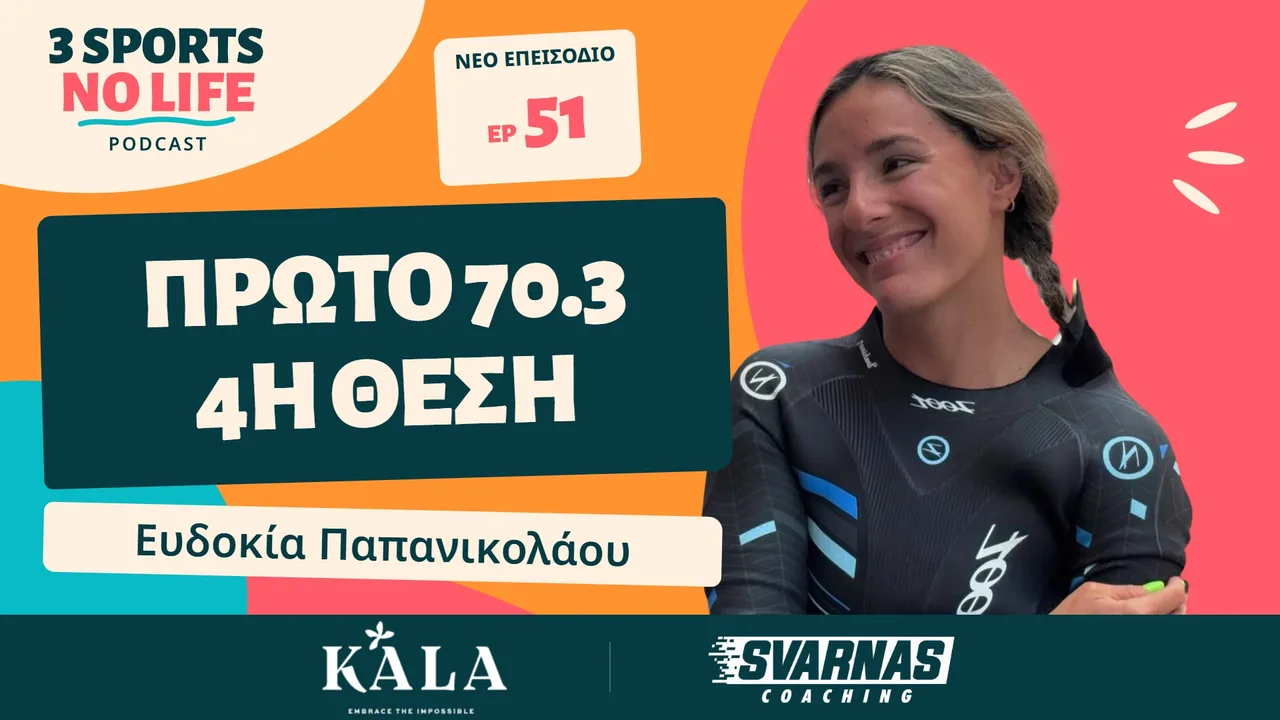
In this episode
Ioanna Mitropoulou traces her journey from running and training groups in Zurich to the IRONMAN 70.3 Greece podium and the 70.3 World Championship in Nice. From a first race on the wrong-sized bike, she went on to pursue personal goals over the middle distance.
She explains how training fits around work, how her approach to fueling changed and how she handled two race disruptions: a delayed bike delivery and a missing bag in the second transition. The conversation also covers patience with progress, her three-hour marathon goal and her wish to race Challenge Roth one day.
Quick navigation
- 00:00 — Introduction and meeting Ioanna
- 03:34 — From running to triathlon and carbohydrates as fuel
- 10:21 — Training groups and sport in Switzerland
- 19:56 — Full-time work and training
- 25:55 — Marathons and the three-hour goal
- 36:16 — The first triathlon on the wrong-sized bike
- 40:53 — Moving up to 70.3 and racing in Rapperswil
- 50:23 — The Costa Navarino podium and mutual inspiration
- 53:41 — The delayed arrival of her bike by air
- 01:01:18 — The World Championship in Nice and improving the swim
- 01:09:32 — The missing T2 bag and respect for fellow athletes
- 01:17:40 — Resetting the race goal and running strongly
- 01:21:11 — The World Championship experience
- 01:26:44 — Next goals and the off-season
- 01:32:36 — Quick-fire questions and why we test
- 01:37:18 — Challenge Roth and thoughts on long-distance triathlon
- 01:40:12 — Closing
Detailed show notes
The training groups that brought her to triathlon
Ioanna discovered triathlon through university sports groups in Zurich. She entered her first race on a second-hand gravel bike that was the wrong size and briefly lost her way on the course. What she remembers most, however, is how much she enjoyed switching between the three sports. The people around her and easy access to training encouraged her to continue.
From calories to fuel
Her original motivation for running was to burn calories, which made it difficult to accept fueling during exercise. Working with George brought a more structured approach to energy intake in training. Jenny Boulmeti describes the shift from worrying about extra calories to seeing carbohydrates as fuel, while Ioanna discusses her own adjustment.
Work and 12–14 hours of training
Flexible working hours allow Ioanna to reserve mornings for focused work and split double training days between lunchtime and the evening. Jenny adds her experience of combining training, work and family. Their conversation highlights different daily routines and the practical limits of the time available.
Marathons and personal progress
Ioanna hopes to approach three hours at the Zurich Marathon in 2027. She recalls preparation that did not translate into the race she wanted, and the recovery following a difficult effort. In Rapperswil, she improved her time without improving her placing: performance is personal, while the ranking also depends on the competition.
Costa Navarino and a difficult journey
Her podium and qualification at 70.3 Greece were especially meaningful because she raced close to her home region with her family present. Before the race came a delayed bike delivery, the search for a backup and a specially arranged check-in on race morning. She and Jenny also remember the event as a source of mutual respect and inspiration.
The missing bag in Nice and a strong run
After a good bike leg, Ioanna could not find her bag in T2. She asked for help, searched with volunteers and eventually found it elsewhere. She continued with a new goal: a strong run, achieving the sub-90-minute triathlon half marathon she had been pursuing. The incident prompts a conversation about being mindful of fellow athletes’ equipment, even in the rush of transition.
Patience in swimming and assessment in training
During the off-season, she wants to focus on swimming technique, accepting that the work may show up in a later season. Her dislike of testing leads to a discussion about why one performance cannot describe an athlete’s whole profile, a topic explored further in the article on the power–duration curve and Critical Power. Challenge Roth remains a future aspiration, with the time available for preparation a key consideration.
Key takeaways
- Training groups gave Ioanna access, knowledge and encouragement to take up triathlon.
- Training needs to fit an athlete’s actual daily routine and available time.
- A faster race time does not always lead to a better placing.
- After losing time in T2, Ioanna found a new goal within the same race.
- Improving her swimming takes patience; she does not expect every training change to show up immediately in the next race.